What is a security sealing device
A security sealing device is a single-use security seal that simultaneously performs both locking and sealing functions. Unlike a conventional padlock, it is a one-time-use device: once installed, it cannot be removed without being destroyed, and any unauthorised opening attempt leaves irreversible marks.
In the logistics and international trade sector, security sealing devices are the direct equivalent of the concept defined by the ISO 17712 standard. They are the primary tool for ensuring cargo integrity during the transport of containers, wagons, trucks and for meter sealing.
How does it differ from an indicative seal
In everyday practice, the terms "seal" and "security sealing device" are often used interchangeably, but there is a fundamental difference between them:
- Indicative seal -- a lightweight device (usually plastic) that merely records the fact of opening. Breaking strength is 15-25 kg. It does not create a significant physical barrier.
- Security sealing device -- combines locking and indicating functions. It creates mechanical resistance to opening ranging from hundreds of kilograms to several tonnes of breaking strength. Removal requires specialised tools (bolt cutters, cable cutters).
Thus, every security sealing device is a seal, but not every seal is a security sealing device. At the international level, security sealing devices correspond to the Security (S) and High Security (H) categories of ISO 17712.
"A security sealing device is not merely an indicator. It is a physical barrier that makes opening without a trace impossible, and makes any tampering attempt obvious."
Types of security sealing devices
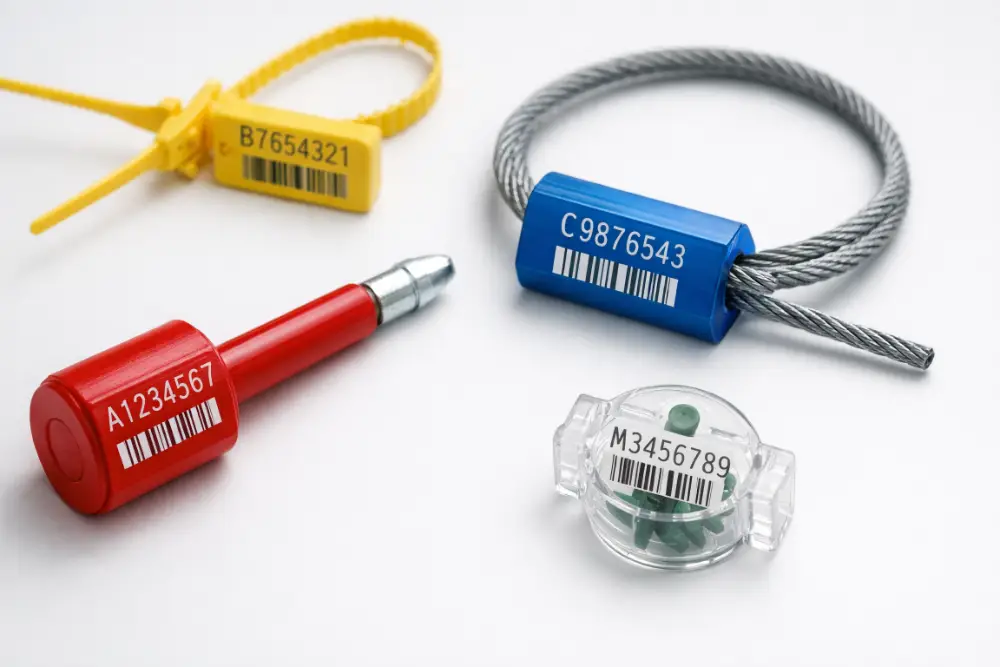
The market offers several structural types of security seals, each optimised for specific operating conditions.
Bolt seals
The strongest type of security seal. They consist of a steel bolt that is inserted into a housing and locked by an irreversible locking mechanism. Breaking strength reaches 20 kN or more (approximately 2 tonnes). The Titan model by Lockwise belongs to this type and is certified to ISO 17712 High Security (H).
- Strength: up to 20 kN (~2,000 kg)
- Certification: ISO 17712 High Security (H)
- Application: maritime containers, customs transport, C-TPAT
Cable seals
They consist of a braided steel cable and a locking body (ABS plastic or metal alloy). The flexibility of the cable allows them to be used on various types of locking mechanisms. Strength ranges from 100 kg to 900 kg or more depending on the cable diameter. The LockIn 2.25 model (2.25 mm cable diameter, 900 kg strength) is certified to ISO 17712 Security (S).
Our specialists will recommend the right model and strength level for each type of transport.
Rod seals
They consist of a metal rod with a locking mechanism at one end. Widely used in rail transport due to their ease of installation and removal. The Garda N model (150 kg strength) is suitable for sealing trucks, warehouses and industrial facilities.
Meter seals
A specialised type of security sealing device developed for energy infrastructure -- water, gas and electricity meters. The MeterLock (patent No. 4534) and OliLock (patent No. 4034) models by Lockwise were created at the request of utility companies and meet specific requirements: resistance to UV radiation, temperature fluctuations and chemical exposure.
ISO 17712 classification
The international standard ISO 17712:2013 is the primary regulatory document defining requirements for security sealing devices in world trade. The standard defines three categories:
| Category | Designation | Breaking strength | Seal type | Application |
|---|---|---|---|---|
| Indicative | I | Not regulated | Plastic seals | Low-risk domestic transport |
| Security | S | minimum 1 kN (100 kg) | Cable seals | Trucks, wagons, medium risk |
| High Security | H | minimum 20 kN (2,000 kg) | Bolt seals | Maritime containers, customs, C-TPAT |
The S and H categories represent true security sealing devices in the classical sense, as they provide not only indication but also physical resistance to opening.
Areas of application
Security sealing devices are used across all industries that require cargo and equipment integrity control:
- Maritime container transport: mandatory use of H category seals for containers in international traffic (C-TPAT and AEO requirement).
- Road transport: sealing of van doors, semi-trailers and refrigerated vehicles with cable seals.
- Rail transport: sealing of hatches, doors and wagon covers with rod and cable seals.
- Customs operations: security sealing devices ensure cargo integrity during transit across different countries.
- Warehouse logistics: access control for storage facilities and container yards.
- Energy infrastructure: sealing of water, gas and electricity meters to prevent resource theft.
- Banking sector: sealing of cash-in-transit bags and bank vaults.
How to choose the right security sealing device
The choice of security seal is determined by three key factors:
- Type of transport or object: a maritime container requires an H category bolt seal; a truck requires an S category cable seal; a meter requires a specialised model.
- Route risk level: international routes and routes through high-risk zones require maximum strength and certification.
- Regulatory requirements: C-TPAT, AEO and national customs regulations determine the minimum seal category for specific operations.
Additional selection criteria include: unique sequential numbering, customisation options (logo, barcode, QR code), resistance to the route's climatic conditions and compatibility with tracking systems.
Lockwise seals
The Lockwise range includes security sealing devices for all major application areas:
| Model | Type | Strength | Certification | Application |
|---|---|---|---|---|
| Titan | Bolt | 20 kN (~2 t) | ISO 17712 H + C-TPAT | Maritime containers, customs |
| LockIn 2.25 | Cable | 900 kg | ISO 17712 S + C-TPAT | Trucks, wagons |
| MeterLock | Meter seal | Specialised | Patent No. 4534 | Water, gas, electricity meters |
| Garda N | Cable | 150 kg | -- | Warehouses, trucks, facilities |
All models feature unique sequential numbering and support customisation. Certification test protocols are available upon request.
Frequently asked questions
What is a security sealing device?
A security sealing device (security seal) is a single-use access control device that simultaneously performs locking and sealing functions. It physically blocks the opening of a container, wagon or truck door and records any unauthorised access attempt through irreversible marks.
How does a security sealing device differ from an indicative seal?
An indicative seal simply records the fact of opening but does not physically prevent it. A security sealing device combines locking and indicating functions: it creates mechanical resistance to opening (from hundreds of kilograms to several tonnes of breaking strength) and simultaneously leaves visible marks upon any tampering attempt.
What types of security sealing devices exist?
The main types are: bolt seals, the strongest, for maritime containers; cable seals, flexible, for trucks and wagons; rod seals, for rail transport; and meter seals, specialised for energy infrastructure.
Is ISO 17712 certification mandatory for security sealing devices?
For international maritime container transport, yes. The C-TPAT programme (USA) requires the use of High Security (H) category seals under ISO 17712. The AEO programme (EU) also includes requirements for certified seals. For domestic transport, certification is recommended but not always mandatory.
How do I choose the right security sealing device?
The choice depends on three factors: type of transport (container, truck, wagon, meter), route risk level and regulatory requirements. For maritime containers: bolt seal ISO 17712 H. For trucks: cable seal ISO 17712 S. For meters: specialised models.