Introduction
Choosing the wrong security seal can lead to financial losses, regulatory non-compliance or legal liability. The market offers a wide range of options — plastic, cable, metal and meter seals — and many companies end up choosing the cheapest model without assessing whether it truly fits their use case.
This guide classifies the main types of security seals by material, strength and application, and provides specific criteria to decide which one is best for each sector. At the end you will find a comparison table that summarises the most common options.
Basic classification: why is there no universal seal?
A security seal is not designed to resist physical attack indefinitely — that is the role of locks and padlocks — but to make any unauthorised access visible. The level of evidence required varies greatly depending on the application: sealing a batch of pharmaceutical samples is not the same as sealing a 20-tonne maritime container.
ISO 17712:2013 establishes three categories for container seals — Indicative (I), Security (S) and High Security (H) — but this classification does not cover the entire spectrum. In practice, there are specific solutions for electricity, gas, water distribution and industrial applications that follow their own sector regulations.
The required security level is not determined by budget, but by the combination of cargo value, tampering risk and the sector’s regulatory requirements.
Plastic seals
They are the most widely used by volume and the most economical. Made of polypropylene or high-strength nylon, their main advantage is ease of application: they require no tools and can be fitted with one hand in seconds. Their main limitation is mechanical strength, which is usually below 150 N in standard models.
Indicative type
They represent the most basic family. Their function is to record access — any break indicates that someone opened the sealed point — without offering meaningful resistance to cuts or forced pulling. They are widely used in retail for cash bags, document archives, e-commerce return packaging and warehouse asset control.
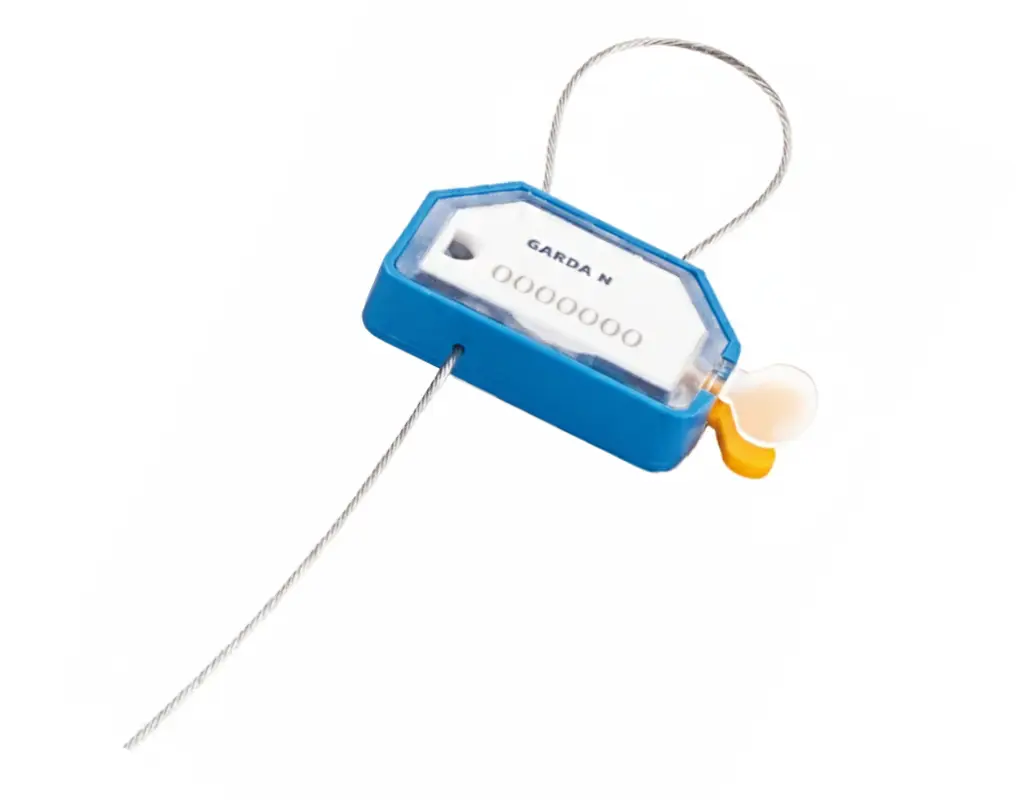
The Lockwise Garda N is representative of this category: it withstands up to 150 kg of pull strength and is available in several colours to simplify coding by route, shift or destination.
Medium-security type
They incorporate more robust locking mechanisms — double latch, internal saw-tooth design — and harder resins that increase strength to 300–600 N depending on the model. Some include laser numbering or custom text to improve traceability. They are common in medium-value cash transport, hospital medication bags and hospitality cash boxes.
Cable seals
They combine a zamak or stainless steel body with a braided steel cable of varying diameter — typically between 1.5 mm and 4 mm. This construction allows them to seal points with irregular geometries: trailer handles, wagon doors, industrial valves or intermediate bulk containers (IBC).
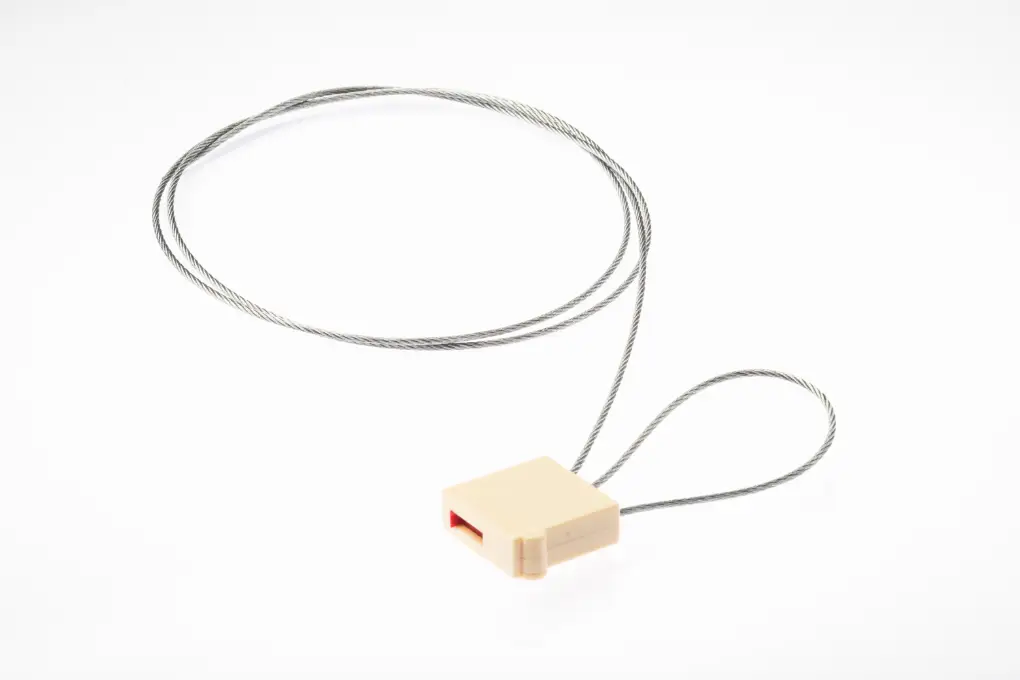
Strength varies considerably depending on the cable diameter and the grade of steel used. The Lockwise LockIn 2.25 has a 2.25 mm diameter and withstands 900 kg of pull strength, meeting ISO 17712 Security category S. For applications that do not require this certification, 1.5 mm models are more economical and sufficient for domestic transport of general goods.
Our team can advise you on the right security level for your fleet or supply chain, with no obligation.
High-security metal seals
They are the benchmark option when regulations require maximum strength or when cargo value justifies the additional investment. Made from carbon steel, stainless steel or high-alloy aluminium, their defining feature is exceeding the 1,500 N threshold set by ISO 17712 for category H (High Security). This makes them mandatory on C-TPAT routes, customs transit with AEO requirements and dangerous goods transport.
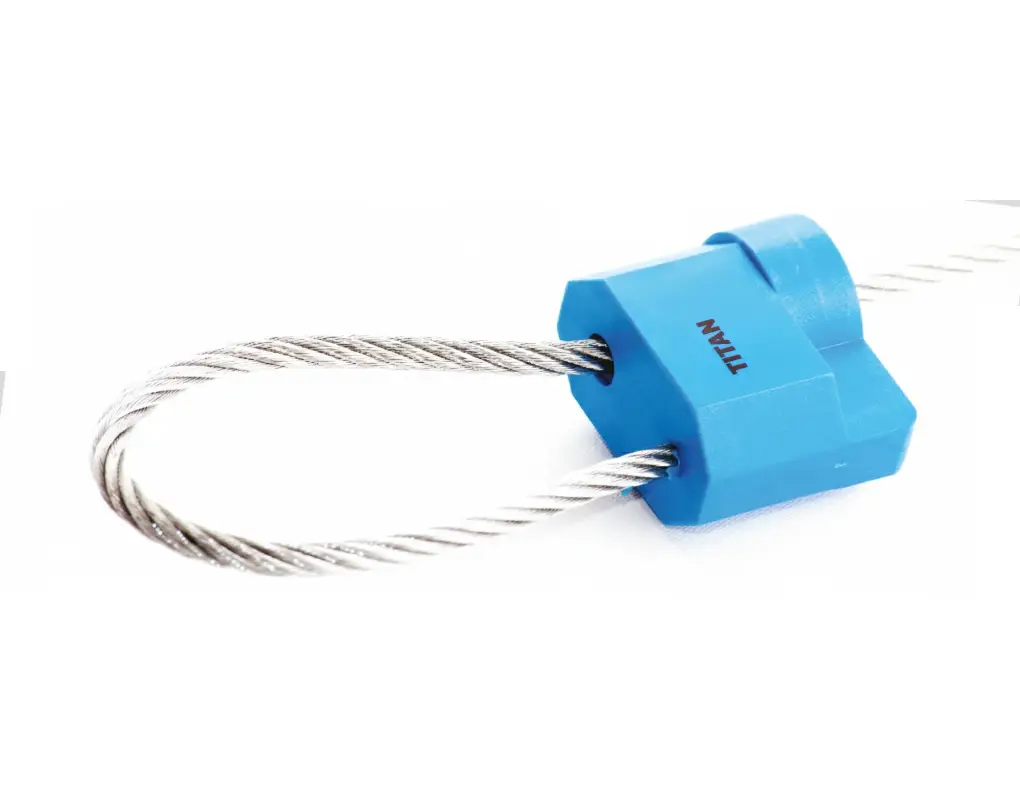
The Lockwise Titan is made of high-strength steel and reaches a breaking strength of 20,000 N (20 kN), more than ten times the minimum required. It includes laser engraving with a unique serial number, allowing seal integrity to be checked by comparing the visible number with the one recorded in the shipping documents.
| Model | Material | Strength | ISO 17712 | Recommended use |
|---|---|---|---|---|
| Titan | High-strength steel | 20.000 N (20 kN) | High Security (H) | Maritime containers, C-TPAT, customs |
| LockIn 2.25 | Steel cable + zinc body | 900 kg (~8.800 N) | Security (S) | Trucks, trailers, rail wagons |
| Garda N | Reinforced polypropylene | 150 kg pull strength | Indicative (I) | Retail, e-commerce, asset control |
Seals for meters and utilities
This segment has very specific characteristics. Seals for electricity, gas or water meters must meet the requirements set by each distributor or sector regulator, which in Spain follow the technical specifications of Red Eléctrica, Enagás and the various water utility operators. ISO 17712 is not the reference here; what matters is the specific approval of each operator.
The most common requirements in this niche include weather resistance (UV, rain, extreme temperatures), absence of false positives under vibration or accidental pressure, and sequential or batch numbering to facilitate installation audits. The OliLock and Lockwise MeterLock models are designed specifically for utilities and energy distribution applications.
Comparison table by sector
The following table summarises the most common types of seals by sector, ordered from lower to higher regulatory requirements:
| Sector | Recommended type | Reference standard | Product |
|---|---|---|---|
| E-commerce / retail | Indicative plastic | No specific regulation | Garda N |
| Domestic road transport | Cable or medium-security plastic | CMR, transport contract | LockIn 2.25 |
| Pharma / food | Plastic or cable with traceability | HACCP, GMP depending on product | Garda N, LockIn 2.25 |
| Foreign trade / containers | High-security metal | ISO 17712 H, C-TPAT, AEO | Titan |
| Electricity / gas / water distribution | Utility-approved plastic | Operator specifications | OliLock, MeterLock |
| Rail / wagons | High-strength cable | RID, UIC standards | LockIn 2.25 |
Common mistakes when choosing a seal
The most common mistake is overestimating mechanical strength without considering traceability. A 20 kN metal seal without individual numbering provides very little documentary assurance, while a lighter plastic seal with a unique serial number can be more useful for audits and incident investigations.
Another recurring mistake is ignoring environmental conditions. Standard polypropylene becomes brittle below -10 °C, which can cause accidental breakage in cold storage rooms or Nordic routes. For these situations, specific nylon formulations are available that remain flexible down to -40 °C.
- Strength without traceability: the serial number matters as much as physical strength.
- Ignoring the temperature range: critical in cold chain and winter routes.
- Not training the team: incorrect application cancels out the seal’s effectiveness.
- Mixing references without criteria: without defining when each model applies, security gaps are created.
- Omitting mandatory certification: on C-TPAT routes or under AEO requirements, a non-certified seal can halt an export shipment.
Conclusion
There is no universal seal. The right choice depends on three factors that must be assessed together: the application’s risk level, the sector’s regulatory requirements and the operating conditions (temperature, geometry of the sealing point, need for documentary traceability).
For most domestic logistics applications, a cable seal like LockIn 2.25 or a reinforced plastic seal like Garda N fully meets the requirements. When international trade or customs are involved, Titan with ISO 17712 High Security certification is the safest option. For utilities and meters, the first step is always to consult the network operator’s technical specifications.